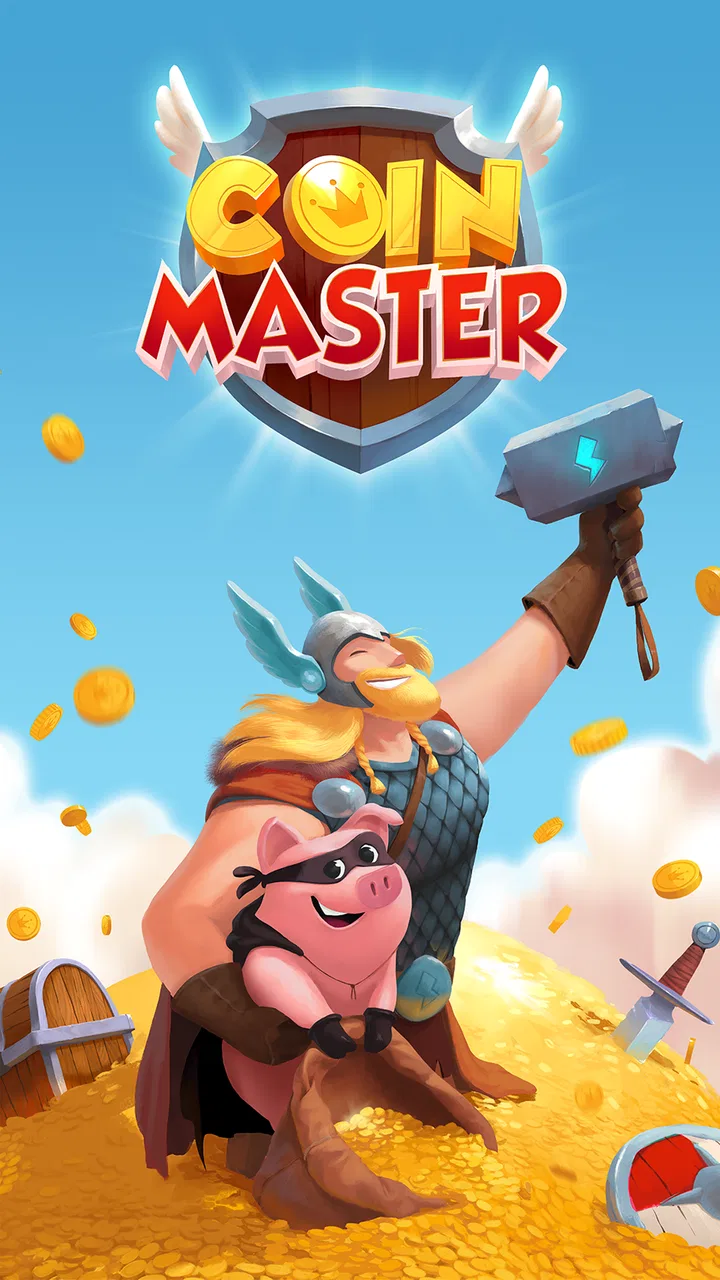
Coin Master
- 4.8
- Rating
- 100.00M
- Installs
- Free
- Price

 Analysis by App-foxy
Coin Master is the kind of casual game I can open with one hand while waiting for a coffee, play for a few minutes, and put away without feeling that I have abandoned a complicated campaign. Its appeal is immediate: spin, collect, build, raid, and decide whether to take one more turn. That loop is easy to understand almost instantly, which is exactly why it has become such a familiar choice for short mobile sessions.
At the same time, the simplicity is also the main thing to examine carefully. This is not a deep strategy game disguised as a casual title. It is a highly repetitive social adventure built around chance, upgrades, and the temptation to keep going. I found it enjoyable when I treated it as a quick break rather than a game demanding constant attention. If you want long-term planning, a rich story, or uninterrupted control over every outcome, you may find its structure limiting.
How the short-session loop feels in everyday use
Moon Active has shaped the experience around a very clear sequence. I use spins to trigger an outcome, gather coins or other useful rewards, and spend those resources on developing the current village. Some turns create opportunities to attack or raid, while others simply move my progress forward. The important point is that every action is easy to read. I never need to study a large menu before understanding what the game expects me to do next.
You May Also Like

 Blood Strike: 2.5 Anniversary
Blood Strike’s Loadouts Turn Every Drop Into a Tactical Gamble
A close look at Blood Strike’s custom loadouts: how fast access to signature weapons reshapes its battle royale rhythm, rewards preparation, and narrows the gap between fights.

 Pandora - Music & Podcasts
Pandora’s Music Is Easy to Start, but Harder to Recover
Pandora’s strength is its low-effort path from a seed to a station. Its weak spot is how much confidence it asks you to place in connection, setup, and quiet recovery.

 8 Ball Pool
 Is Built on Rivalries, Rematches, and Routine
A close look at the rivalries, rematches, shared routines, and unanswered safety questions that turn a quick pool match into a persistent mobile community.

 Samsung Music
’s Quiet Strength Is Playing What You Already Own
Its reach comes less from spectacle than from dependable access to a personal library. That simplicity is both the app’s strongest retention engine and its ceiling.

 AccuWeather: Weather Radar
AccuWeather Review: A Quick, Clear Forecast for Everyday Decisions
For everyday plans, the best forecast is the one you can understand quickly. AccuWeather makes rain timing, radar, and local conditions easy to act on, with a few trade-offs.

 Hill Climb Racing
Why Hill Climb Racing Still Turns Crashes Into One More Run
A tiny car, a bumpy hill and one more upgrade: Hill Climb Racing keeps resurfacing because its simple chaos makes every near-miss feel personal.
More From Our News Desk
View All News


That clarity makes the opening minutes particularly effective. A new player can see the immediate goal, tap through the available actions, and understand why coins matter. The game does not ask me to memorize a complicated combat system or manage a large team. Instead, it offers a compact chain of small decisions: use a spin, collect the result, improve the village, and consider whether another attempt is worthwhile.
In my experience, this works best in the gaps of an ordinary day. I might play while waiting for a bus, during a short lunch break, or when I want something more active than scrolling but less demanding than a full console-style game. A session can end naturally after the available action is used, which reduces the pressure to commit to a long play period.
The immediate pleasure comes from visible movement. A completed building or village upgrade gives the session a sense of closure, even when the underlying action was brief. I like that the game regularly presents a small reason to return rather than requiring me to remember a complicated objective from the previous evening.
However, the outcome of a spin is not fully under my control. That creates excitement when the result is useful, but it also means careful planning cannot always rescue an unlucky sequence. Players who prefer direct skill tests may find the central loop less satisfying than puzzle games, card battlers, or traditional strategy titles. Here, the pleasure comes from anticipation and collection as much as from decision-making.
Why the first few minutes are so accessible
The game communicates through familiar visual rewards and short actions. Coins, village improvements, attacks, and raids are easy concepts to grasp without a tutorial becoming the main event. I can usually tell what I have earned and what I can do with it, which keeps the interface approachable for people who do not normally play complex mobile games.
This accessibility is one reason the game suits mixed-age groups within its stated Teen rating. It feels social and playful rather than intimidating, although the attack-and-raid theme may not appeal to everyone. Parents should also remember that the free download includes optional purchases, so the experience is better approached with spending controls in mind.
The game is free to start, but individual in-app purchases range from $0.49 to $374.99. That wide range matters more than the low entry cost. I can enjoy the basic loop without paying, yet the design can still make extra spins, progress, or convenience feel tempting. My practical advice is to decide before playing whether purchases are part of your plan, rather than making that choice during a frustrating run of poor results.
What a normal break with the game looks like
Imagine having seven minutes before an appointment. I open the game, check the current village, use the available spins, and see whether the results give me enough coins to complete an upgrade. If an attack or raid appears, I choose it and enjoy the quick burst of interaction. I can then close the app after a small piece of progress instead of leaving a mission half-finished.
That scenario shows the game at its best. It does not require a quiet room, a notebook, or a long uninterrupted block of attention. The individual actions are short, and the visual feedback makes even a modest session feel complete. I would recommend it to someone who wants a light routine of checking in rather than a game that demands a serious evening commitment.
The trade-off is that a short session may end just as the game has created another reason to continue. A near-complete village, a promising reward, or an unsuccessful raid can all encourage another visit. The interruption-friendly design is real, but it is paired with a deliberate return impulse. Whether that feels motivating or manipulative depends largely on how easily you can stop once the immediate goal is reached.
Returning after a pause, and the cost of repetition
One of the strongest parts of the experience is how easy it is to come back after a break. I do not need to reconstruct a complicated plot or remember a chain of objectives. The current village and its next upgrade provide enough context. That makes the game comfortable for people who play irregularly, especially those who prefer several short visits over one long session.
The pause-and-return design also makes it suitable for casual social play. If friends are already playing, attacks and raids can add a personal edge to what would otherwise be a solitary collection loop. The social layer gives progress more emotional weight: a successful action against another player feels more memorable than simply receiving another anonymous reward.
Still, I would not describe the social element as a replacement for a fully developed multiplayer game. The attraction is the light rivalry and the feeling that other players are connected to my progress, not deep teamwork or coordinated competition. If your ideal mobile game involves voice communication, carefully balanced matches, or direct tactical control, this will feel much lighter.
The biggest question is whether the repetition remains pleasant. The basic pattern does not change dramatically: spin, receive an outcome, collect resources, improve the village, and repeat. New progress targets can make that pattern feel fresh for a while, but the underlying action remains familiar. I enjoyed the predictability when I wanted something relaxing. After longer sessions, however, I became more aware that I was repeating the same gestures for increasingly small gains.
This is where Coin Master differs from many alternatives in the casual category. A match-three game usually asks me to solve a new board, while a word game tests a different set of skills each round. An endless runner depends more directly on reflexes, and a management game often gives me more control over long-term planning. Coin Master sits closer to a reward-driven collection routine: the satisfaction comes from the next result and the next upgrade rather than from mastering a changing challenge.
How to keep the loop enjoyable
I get more from the game when I set a natural stopping point before starting. Completing one village task, using a limited set of available actions, or playing only during a particular break keeps the repetition from taking over the day. This is not a rule the game imposes, but it is a useful habit because the loop is designed to make another turn feel attractive.
I also recommend treating coins and upgrades as short-term goals rather than proof of skill. A lucky outcome can accelerate progress, while an unlucky one can slow it down, so comparing your pace with another player may create unnecessary frustration. The more relaxed my expectations are, the more I appreciate the game’s quick bursts of feedback.
Another practical approach is to separate social enjoyment from competitive pressure. Raiding friends can be entertaining when everyone understands the playful nature of the interaction. It is less enjoyable if you dislike games that turn friendships into targets or if losing progress feels personal. In that case, a solo puzzle or decorating game may be a better fit.
Where the free model changes the experience
The purchase system deserves attention because it affects the rhythm even when I choose not to spend. A free-to-play structure can make progress feel generous in one session and restricted in another, depending on the results I receive. The game remains approachable, but the desire to continue may arrive before the resources needed to continue do.
For me, the healthiest way to play is to regard purchases as optional acceleration, not as a requirement for the game to be worthwhile. I would avoid buying anything simply because I am annoyed by a bad result. If the enjoyment depends on removing every pause or speeding through every village, the core loop may not be strong enough for that player without spending.
The Teen content rating is also relevant for households. The theme is cartoonish and casual, but the social attacks and purchase prompts may not suit every younger player. Anyone sharing a device should use the platform’s purchase protections and discuss expectations in advance. That advice is especially important because the game is free to install, which can make optional spending feel less noticeable at first.
Performance, access, and who should choose it
The current version is 3.5.2430, and the game supports devices running Android 6.0 or later. It has been available since February 4, 2016, so it is not a new experiment trying to discover its identity. Its long presence and broad audience are reflected in an average rating of 4.8 from around 10 million ratings, with roughly 686 thousand written reviews and over 100 million installs.
Those figures suggest that the format has connected with a very large audience, but popularity does not remove the personal trade-offs. I would choose it for quick, low-effort sessions, light rivalry with friends, and a progression system that is easy to understand. I would skip it if I need a game where every result follows from precise skill, where repetition changes substantially from round to round, or where spending never enters the design.
Compared with a traditional board game app, Coin Master offers faster rewards and less setup, but also less control over the outcome. Compared with a farming or town-building game, it provides more immediate action and social friction, but less calm customization. Compared with a competitive battle game, it is much easier to interrupt, though it lacks the intensity and depth of a live match. Those differences make the choice fairly clear: this is for casual momentum, not serious mastery.
My recommendation after living with the rhythm
I recommend Coin Master to players who enjoy checking in several times a day, collecting resources, and seeing a village gradually develop through short bursts of activity. It is especially convenient for people who want a game that explains itself quickly and can be put down without losing the thread. The attack and raid mechanics add just enough social tension to stop the experience from feeling like a completely passive reward screen.
I would be more cautious about recommending it to anyone who is sensitive to repetitive loops or chance-based progress. The central appeal can wear thin when the same actions are repeated without a meaningful change in challenge. Players who are trying to avoid optional purchases should also establish firm limits before they begin, because the free entry point does not mean every route through the game is equally frictionless.
My final view is positive but specific: this is a good interruption-friendly casual game, not an all-purpose mobile adventure. Its greatest strength is the ability to create a small, understandable moment of entertainment almost anywhere. Its main weakness is that the same clarity can become routine, and the return incentives can make a five-minute visit stretch longer than intended.
If you approach it as a playful collection habit, keep sessions short, and accept that luck influences progress, the design makes sense. If you want deep strategy or a constantly changing challenge, I would point you toward a puzzle, management, or skill-based alternative instead. For the right player, though, Moon Active’s game delivers a simple pleasure: open it, make a few moves, see something grow, and leave with a clear sense of what to do next time.
FAQs for Coin Master
01What is the main objective of Coin Master?
Coin Master is a casual mobile game where the primary goal is to build and upgrade your village using coins you earn. Players spin a virtual slot machine to win coins, attack other players’ villages, or raid their coin stash. The game blends elements of strategy, luck, and social interaction.
02How can I earn more coins in Coin Master?
Coins in Coin Master are primarily earned by spinning the slot machine, which can award coins directly or through successful raids and attacks on other players’ villages. Additionally, players can complete village upgrades, participate in events, and receive gifts from friends to boost their coin reserves.
03Are there any in-app purchases in Coin Master?
Yes, Coin Master offers a variety of in-app purchases. Players can buy spins, coins, and chests to progress more quickly. While the game can be played without spending money, purchasing these items can enhance the experience by allowing faster village upgrades and more frequent spins.
04Is Coin Master a multiplayer game?
Coin Master incorporates social features that allow players to interact with friends and other players worldwide. You can connect through Facebook to raid or attack friends' villages, send and receive gifts, and compete on leaderboards. However, the gameplay itself is mostly single-player focused.
05What are the age requirements for playing Coin Master?
Coin Master is rated for players aged 12 and older due to its mild cartoon violence and in-app purchases. Parents should be aware of the social interactions and the potential for spending real money, and they may want to use parental controls to manage their child’s gaming experience.
Pros
- Engaging gameplay with progressive challenges.
- Vibrant graphics and animations.
- Frequent updates keep content fresh.
- Social features enhance multiplayer fun.
- Offline play available for convenience.
Cons
- In-app purchases can be costly.
- Game may become repetitive over time.
- Ads can be intrusive for some users.
- Requires stable internet for certain features.
- Limited strategic depth in gameplay.

Coin Master
Gallery